
How forehead wrinkles develop and what you can do about them
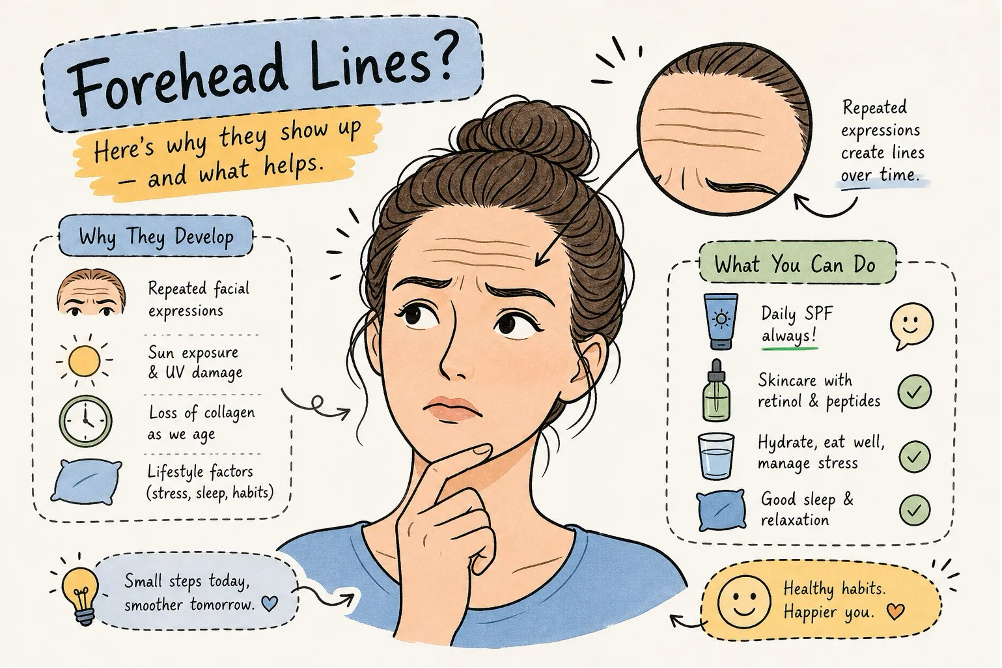
If you have ever wondered why do forehead wrinkles develop, the answer involves two forces working simultaneously. The frontalis muscle repeatedly folds the overlying skin, while collagen and elastin, once responsible for helping skin spring back, gradually break down. UV exposure compounds both processes and accounts for an estimated 70 to 80 percent of visible facial ageing at a population level.
Understanding these causes is not just academic; it directly determines whether prevention or treatment is the right next step for you.
Forehead lines are often the earliest signs of facial ageing that people notice, appearing first as fleeting creases during expression before gradually settling into permanent features. The good news is that once you understand what is driving your lines, you have real options to slow the process and address what is already there.
Key takeaways
- Two root causes: Forehead wrinkles result from repeated frontalis muscle movement combined with age-related collagen and elastin loss, not from either factor alone.
- UV is the biggest driver: Cumulative sun exposure accounts for roughly 70 to 80 percent of visible facial ageing, making daily SPF the highest-impact preventive habit.
- Dynamic lines become static over time: Lines visible only during expression can eventually become permanent creases, and the type of line determines which treatment works best.
- Smoking accelerates ageing significantly: Current smokers showed over six times the odds of significant facial wrinkling compared with non-smokers in one facial ageing analysis.
- Treatments must match the line type: Neuromodulators work best for dynamic lines; laser resurfacing and skin tightening address static lines and dermal remodelling.
- Start early at home: A broad-spectrum SPF and a topical retinoid are the most evidence-backed athome steps for slowing forehead ageing.
Why do forehead wrinkles develop: the underlying causes
The frontalis muscle runs vertically across the forehead and contracts every time you raise your brows, during surprise, concentration, or simply following a conversation. Each contraction folds the skin into horizontal creases. In younger skin with healthy elastin, those folds resolve completely when the face relaxes. As dermal support weakens over time, the fold takes longer to disappear, and eventually it stays put.
As you age, your skin’s structural framework changes on several fronts. Fibroblast activity slows, so less collagen is produced. Matrix metalloproteinase activity increases, so existing collagen is fragmented faster. And elastin becomes both quantitatively deficient and structurally disorganised, meaning the skin’s ability to recoil after each contraction diminishes. Think of collagen as the scaffolding and elastin as the elastic band: age depletes both simultaneously, leaving progressively less structural resistance to each muscle movement.
The dermis also loses epidermal hyaluronic acid and overall thickness, which means there is less cushioning between the skin’s surface and the muscle beneath it. A thinner dermis simply cannot absorb the mechanical force of repeated muscle contractions the way younger skin can. This is why forehead ageing is not just about how expressive you are; it is about the cumulative structural changes happening beneath the surface over decades.
UV exposure dramatically accelerates this entire process. Ultraviolet radiation generates reactive oxygen species that activate the same matrix metalloproteinases responsible for normal age-related collagen fragmentation. Singapore’s equatorial location and frequent high UV index mean daily UV exposure is a relevant factor for most people here, even a commute, a walk to lunch, or sitting near a window adds to your lifetime total.
What is the difference between dynamic and static forehead lines?
Dynamic lines are visible only during expression, when you raise your brows, frown, or squint, and they disappear completely when your face is at rest. Static lines remain visible even when your face is fully relaxed. The practical self-test is straightforward: relax your face in front of a mirror and let every muscle go. Lines that persist are static; lines that vanish are still dynamic.
The transition from dynamic to static commonly takes two or more decades of habitual movement, though genetics, sun exposure, smoking, and skin type all shift this timeline considerably between individuals. What happens is that repeated folding, combined with progressive loss of collagen, elastin, and dermal thickness, eventually means the crease can no longer fully resolve at rest. The fold has been pressed into the skin long enough that the structural changes become permanent.
This distinction matters clinically because the two types respond to different treatments. Dynamic lines respond well to neuromodulators because addressing the muscle addresses the cause. Static lines involve established structural changes in the dermis and typically require a broader approach that remodels the tissue itself.
The glabellar “11” lines, the vertical creases between the brows, follow the same dynamic-to-static
progression but involve different muscles. The corrugator supercilii pulls the brows inward, while the procerus pulls the central brow downward, creating those characteristic vertical folds. Because the muscles and anatomy differ from the frontalis, the two areas are assessed and treated separately in clinic, even though the underlying ageing biology is the same.
Which lifestyle habits are making your forehead lines worse?
Smoking has the strongest and most consistent association with earlier, more severe facial ageing among all lifestyle factors. One facial ageing analysis found current smokers had over six times the odds of significant facial wrinkling compared with non-smokers, with a clear dose-response relationship. Smoking amplifies matrix metalloproteinase activity and impairs collagen synthesis through an oxidative pathway similar to UV, so the two exposures compound each other rather than simply adding up.
Heavy alcohol intake is also associated with more upper-facial lines, though the evidence is less consistent than for smoking. In a multinational survey, heavy drinking, defined as at least eight drinks per week, was associated with increased upper-facial lines. Poor sleep is a separate concern, linked to impaired barrier recovery and lower skin elasticity. Chronic stress has also been associated with accelerated perceived facial ageing; research from a multinational cohort found stress associated with crow’s feet at three times the odds, with plausible hormonal pathways that likely affect the whole face.
Diet plays a supporting role that is harder to quantify precisely. Diets high in sugar promote glycation, a process that stiffens and cross-links collagen fibres, while fruit- and vegetable-rich diets correlate with fewer visible ageing signs. The forehead-specific data here is limited, but the broader principle holds: skin quality reflects what is happening internally, not just what you apply topically or how much sun you get.
What can you do right now to slow forehead ageing?
If you do only one thing, make it consistent broad-spectrum SPF. Given that UV exposure accounts for an estimated 70 to 80 percent of visible facial ageing, sun protection is structurally different from any topical repair strategy. It does not reverse existing lines, but it is the most evidence-supported way to slow the rate at which new ones form and existing ones deepen. For Singapore conditions, a broad-spectrum SPF 30 to 50 applied every morning is the baseline, with reapplication every two hours if you are spending extended time outdoors, and immediately after swimming or heavy sweating.
Topical retinoids are the most evidence-backed ingredient for fine wrinkles and photodamage. Tretinoin at prescription strength produces the most consistent results; over-the-counter retinol is gentler with more gradual effects. First-time users should start at 0.025 to 0.05 percent retinol, applied two nights per week, increasing frequency gradually only if there is minimal irritation. Expect subtle texture changes after roughly six to twelve weeks, with forehead fine lines typically showing improvement after three to six months of consistent use. Set honest expectations: retinoids work best for fine, sun-related static lines rather than pronounced dynamic creases, and they require ongoing use to maintain results.
Beyond SPF and retinoids, reducing unnecessary habitual expressions has a reasonable mechanical rationale. Use sunglasses to avoid squinting in bright light. Be mindful of persistent brow furrowing during screen work. Sleeping face-down repeatedly presses the forehead into a pillow, adding a mechanical folding force on top of the muscle-related one. These are not dramatic interventions, but they address the mechanical side of the equation with low effort.
What clinic treatments actually work for forehead wrinkles?
Clinic treatments are most effective when matched to the specific type of line present. The table below gives an overview of the main options and what each is best suited to.
| Treatment | Best suited for | Typical duration of results | Approximate downtime |
| Neuromodulators (botulinum toxin type A) | Dynamic horizontal forehead lines and “11” glabellar lines | 3 to 4 months before retreatment | Minimal; mild redness at injection sites settles quickly |
| Skin tightening (radiofrequency / HIFU) | Skin laxity, mild to moderate static lines, dermal remodelling | Results develop over 2 to 6 months; duration varies | Little to no downtime; mild redness or warmth resolves within hours to a few days |
| Fractional laser resurfacing (ablative) | Sun damage, superficial to moderate static lines, uneven texture | Months to a few years depending on ongoing sun protection | 1 to 2 weeks of visible recovery; ongoing remodelling for weeks after |
| Fractional laser resurfacing (nonablative) | Fine static lines, texture, photodamage; multiple sessions usually needed | Progressive improvement; maintenance sessions often required | Minimal; mild redness for a day or two |
| Chemical peels (superficial) | Surface texture, pigmentation, fine lines from photodamage | Up to approximately 6 months; maintenance sessions needed | Minimal; some peeling and redness for a few days |
Botulinum toxin type A is the most evidence-backed treatment for dynamic horizontal forehead lines. In a randomised, placebo-controlled study, 61 percent of patients achieved a clinically significant two-grade improvement at day 30, compared with zero percent in the placebo group, with benefit beginning around day 7 and persisting through day 120. Results are real and meaningful, but dosing matters considerably: too much relaxation of the frontalis can cause brow heaviness, so experienced injection technique is essential. Not every forehead is the same, and factors like brow position, existing skin laxity, and muscle strength all influence how neuromodulators are dosed and placed.
For lines that remain at rest, the approach shifts to remodelling the dermis rather than relaxing the muscle. Radiofrequency and HIFU technologies stimulate collagen production in the deeper dermis, producing gradual tightening over weeks to months with little downtime. Fractional laser resurfacing works through controlled surface remodelling: ablative fractional lasers produce more significant changes but involve one to two weeks of visible recovery, while non-ablative options have less downtime but typically require multiple sessions. Results from resurfacing can last from several months to a few years, depending on ongoing sun protection and lifestyle, but they do not stop the natural ageing process from continuing.
The right treatment starts with the right assessment
Understanding why forehead wrinkles develop, the interaction of repeated muscle movement, progressive collagen and elastin loss, and accumulated UV damage, matters because treatment is rarely onedimensional. Botulinum toxin best addresses dynamic lines; resurfacing treatments best address sun damage and superficial static lines; and many patients benefit from a combination, but that combination should be sequenced and dosed for their specific skin, not applied generically.
The earlier you understand what is driving your forehead lines, the more options you have available.
If you are asking why forehead wrinkles develop on your skin specifically, a personalised consultation gives you a clearer answer than any general guide can. Get in touch with our team to book yours.
Frequently Asked Questions
How soon will I see results after neuromodulator injections for forehead lines?
You can expect benefit to begin around day 7 and many patients achieve a clinically significant improvement by day 30, with typical results lasting about three to four months. Dosing and injection technique matter, so the degree and duration of visible change depend on your muscle strength and brow position, and retreatment is usually needed every few months.
How long before topical retinoids make a noticeable difference to forehead fine lines?
You should expect subtle texture changes after roughly six to twelve weeks and forehead fine lines typically show improvement after three to six months of consistent use. Start gently and increase frequency only if irritation is minimal, and remember retinoids work best for fine, sun-related static lines and require ongoing use to maintain results.
Can lifestyle changes reverse static forehead lines that are already present?
Lifestyle changes alone do not reverse established static lines, though they can slow further progression and improve skin quality. Sun protection and stopping smoking, plus habits that reduce mechanical folding, address major drivers and support any topical or clinic treatments that remodel the dermis.
Is it helpful to combine clinic treatments for forehead wrinkles?
Combining treatments can be beneficial because different approaches target different causes, but combinations should be sequenced and dosed for your specific skin rather than applied generically. Neuromodulators address dynamic muscle movement while resurfacing or skin-tightening procedures remodel the dermis, and effective plans balance these goals based on your anatomy and lifestyle.
Does smoking really make that much difference to how early or severe my forehead wrinkles will be?
Yes, smoking is strongly associated with earlier and more severe facial ageing; one analysis found current smokers had over six times the odds of significant facial wrinkling compared with non-smokers. Smoking amplifies the same destructive pathways as UV, impairing collagen synthesis and increasing matrix metalloproteinase activity, so it compounds sun damage rather than just adding to it.
 English
 Chinese (Simplified)
 Japanese
 Khmer
 Korean
 Malay
 Myanmar (Burmese)
 Thai
 Vietnamese