
Common lifestyle factors that lead to frown lines and how to prevent them
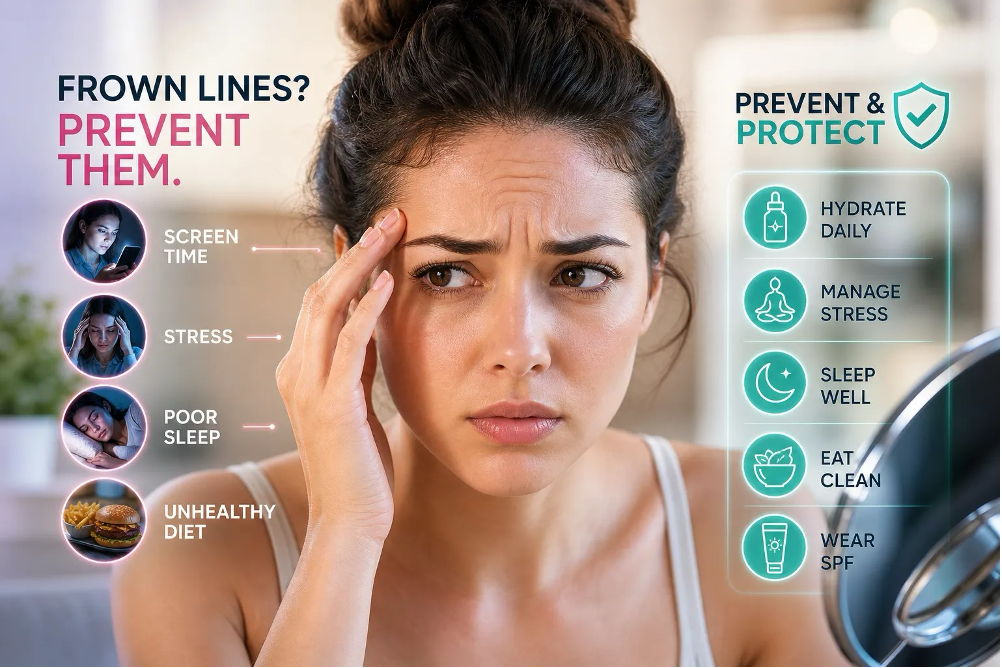
If you are wondering what lifestyle factors contribute to frown lines, the evidence points clearly to three primary causes: repetitive facial muscle contraction, cumulative UV exposure, and smoking. Stress, poor sleep, and dehydration play a secondary role at best, mostly by weakening the skin’s ability to recover rather than creating the lines themselves. Knowing this changes what you should actually prioritise.
It is rarely one thing working in isolation. The causes of frown lines are typically a combination of small, daily behaviours that compound over years until the lines are already sitting there at rest.
Key takeaways
- Primary culprits: Repetitive brow muscle contraction, UV exposure, and smoking have the strongest peer-reviewed evidence for causing frown lines.
- Secondary factors: Stress, poor sleep, and dehydration affect skin recovery but are not proven independent causes of permanent lines. Heavy alcohol use has moderate evidence for increased facial wrinkling.
- Top prevention habit: Daily broad-spectrum SPF 30 or higher has the strongest controlled evidence for slowing photoageing, especially in Singapore’s climate.
- Topical retinoids work: Prescription tretinoin and over-the-counter retinol have consistent trial evidence for improving fine lines through collagen remodelling.
- Clinical options: Injectables that relax the brow muscles are first-line for dynamic lines; laser resurfacing and skin tightening address structural damage in established static lines.
- Act before lines set: Dynamic lines typically become static in the mid-30s to mid-40s. The earlier you address contributing habits, the less there is to correct.
How a frown becomes a permanent crease
The muscles behind glabellar lines
The corrugator supercilii and procerus muscles sit between your brows. When you frown, concentrate hard, or squint, they contract and fold the overlying skin into a vertical crease. That is the central mechanism behind glabellar lines, what people often call the “elevens.” UV damage, ageing, and smoking accelerate how quickly those folds become permanent, but the muscles are why the pattern appears between the brows in the first place, not somewhere else on the face.
This is worth understanding because it changes how you think about prevention. No amount of moisturiser relaxes a muscle. The structural causes and the behavioural causes are different problems, and they warrant different responses.
When dynamic lines turn static
Early on, the crease disappears within seconds of relaxing your face. That is a dynamic line, and it means the skin still has enough elasticity to rebound. Over time, as collagen and elastin break down from ageing, UV exposure, and thousands of repeated folds, the same crease takes longer to fade after each contraction. Eventually it stays visible at rest, even when your face is completely relaxed. That is a static line, and it is a different stage of the same process.
The transition from dynamic to static typically happens somewhere in the mid-30s to mid-40s. But it is not a fixed timeline. Genetics, skin type, how habitually expressive your face is, and cumulative UV exposure all shift that window. Someone with high daily UV exposure and a habit of deep-concentration frowning can see static lines significantly earlier. Act on the contributing habits before that transition and there is far less to correct.
What lifestyle factors contribute to frown lines: ranked by evidence
Not every factor carries equal weight. The table below summarises what the peer-reviewed evidence actually supports for glabellar line formation and deepening.
| Lifestyle factor | Role in frown line formation | Strength of evidence | Notes |
| Repetitive brow muscle contraction | Primary, direct cause of the glabellar pattern | Strong | The corrugator and procerus muscles create the specific “11” pattern through repeated folding |
| Cumulative UV exposure | Amplifies and accelerates permanence | Strong for photoageing; less specific to glabellar lines alone | Degrades collagen and elastin, reducing skin’s ability to rebound between folds |
| Smoking | Accelerates structural skin damage | Good for overall facial wrinkling; weaker site specific evidence | Impairs collagen production, reduces blood flow, and increases tissue stiffness |
| Heavy alcohol use | Associated with increased upper-face lines | Moderate; mainly for heavy use | Evidence is stronger for heavy intake; not every study finds an association |
| Chronic stress | Indirect: may increase involuntary brow tension and impair skin repair | Plausible but limited direct evidence | Keeps skin in a state of slower recovery rather than causing lines independently |
| Poor sleep | Indirect: reduces overnight repair | Limited direct evidence | Compounds the effects of expression and UV damage during the day |
| Dehydration | Makes existing lines look more prominent temporarily | Insufficient for permanent formation | Not a proven cause of new, permanent frown lines |
Repetitive brow muscle contraction is the most direct cause of the glabellar pattern. UV exposure amplifies this by reducing the skin’s structural resilience, making it progressively harder to recover between daily folds. The two factors work together, which is why sun protection is as relevant to frown lines as it is to pigmentation.
Singapore’s equatorial position makes UV a more pressing concern here than in most other cities. According to Singapore’s National Environment Agency, the UV index reaches “Very High” or “Extreme” levels at midday throughout the year, every month. Daily maximums sit substantially above cities like Tokyo or Hong Kong. Sun protection is not a beach-day measure in this climate. It is a daily baseline.
Squinting deserves a mention on its own because it recruits the same corrugator and brow muscles as habitual frowning, yet people rarely connect the two. Squinting outdoors in strong sunlight and squinting at a bright or glare-affected screen in a cool office are both repetitive contraction triggers. For Singapore office workers commuting through intense equatorial sunlight and then sitting at a screen for hours, these exposures accumulate quietly across years.
What stress, poor sleep, and dehydration actually do
None of these three factors have strong direct evidence for permanently etching frown lines on their own. What they do is keep the skin in a state where it recovers more slowly from the expression-related and UV related damage it accumulates every day. That is a meaningful indirect effect, but it is worth being precise about it. Heavy alcohol use sits in a different category, there is moderate evidence linking heavy intake to increased facial wrinkling, though not every study finds the association.
Chronic stress increases involuntary brow muscle tension and may impair skin repair through neuroendocrine and inflammatory pathways. Poor sleep compounds this by reducing the overnight window for cellular repair. In Singapore’s high-pressure work culture, neither is a purely theoretical concern. The practical implication is not that stress causes lines but that it narrows the skin’s margin for recovery, allowing lines driven by other factors to deepen faster.
Temporary dehydration makes existing lines look deeper and more prominent by reducing the water content in the outer skin layer. This is a surface-level visibility effect, not a mechanism for creating new permanent grooves. Singapore’s air-conditioned indoor environments lower indoor humidity despite the tropical climate outside, which can increase transepidermal water loss and leave skin looking drier and more creased by mid-afternoon. A moisturiser with humectants addresses this, though it does not reach the structural causes of permanent wrinkles.
Prevention steps with actual clinical evidence behind them
Daily broad-spectrum SPF 30 or higher is the highest-impact daily habit, with the strongest controlled evidence for slowing photoageing. In Singapore, this means applying every morning without exception and reapplying after outdoor exposure. Pairing sunscreen with sunglasses also reduces squinting around the brow area, addressing two contributing factors in one habit. The American Academy of Dermatology recommends broad-spectrum SPF 30 or higher as the daily minimum, with SPF 50 or higher preferable for prolonged outdoor exposure.
Topical retinoids have consistent clinical trial evidence for improving fine lines by promoting collagen remodelling. Prescription tretinoin is the most studied option; over-the-counter retinol is a milder starting point for those building tolerance. Moisturisers improve temporary skin texture and reduce the dryness that makes existing lines appear more prominent, though they do not prevent the permanent structural progression that comes from repeated muscle activity and UV exposure.
A few screen-time habits are worth building into the working day. Positioning your monitor at eye level prevents sustained upward or downward squinting. Following the 20-20-20 rule, looking away from the screen every 20 minutes for 20 seconds, gives the brow muscles genuine rest during long sessions. These are small changes individually. Over time, they may modestly reduce the cumulative contraction load on the corrugator muscles; evidence for a substantial lifetime effect is limited, but the habit costs nothing and supports the broader goal of reducing repetitive brow movement.
When skincare alone reaches its limit
There is a point where consistent SPF and a good retinoid cannot shift what is already visible at rest. That is not a failure of skincare; it is the stage where the problem has moved beyond what topical products are designed to address. Clinical treatment becomes the more appropriate tool at this point, and the right choice depends on where the lines actually are in their progression.
For lines that are still primarily dynamic, present with expression but gone at rest, injectables that relax the corrugator and procerus muscles are the most evidence-backed clinical option. According to the American Academy of Dermatology, some people notice improvement within a few days, with the full effect generally visible within ten to fourteen days; results typically last around three to four months. The goal is not to eliminate expression but to reduce the repetitive folding that deepens the crease over time, giving the skin a chance to recover between treatments.
When a crease is already visible at rest and skincare has not moved it, laser resurfacing and skin tightening treatments can remodel underlying collagen and improve skin texture and line depth. These address structural damage that has already accumulated rather than the muscle activity creating it. Nonablative approaches typically require multiple sessions; ablative resurfacing delivers more significant results with longer downtime. Both work alongside injectable treatments rather than replacing them.
At Define Aesthetic, our consultations are designed to assess what is actually driving the lines before recommending any treatment path. The mix of muscle activity, photoageing, and skin laxity varies from person to person, and so does the appropriate starting point. A plan built around your actual skin may start conservatively and escalate only if needed. Get in touch with our team to book a consultation and find out where your lines actually stand.
The straightforward summary
To recap what lifestyle factors contribute to frown lines: the causes with the best evidence are the ones most within your control. Reduce habitual brow contraction, apply broad-spectrum sunscreen daily, and do not smoke. In Singapore’s high-UV, screen-heavy environment, those three priorities are more urgent than in cities with a milder climate or a more forgiving UV index.
Stress, sleep, and hydration are not irrelevant, but do not let them become a distraction from the fundamentals. Get the basics right first. Add a tolerated retinoid if your skin handles it. Build in screen breaks. Wear sunglasses outdoors. Those habits do not require a clinic visit, and they are more effective the earlier you start them.
When those measures reach their limit, clinical options like injectables and laser resurfacing offer meaningful improvement, particularly before lines become fully static. The earlier you act on both the daily habits and, if necessary, professional treatment, the less there is to correct.
Frequently Asked Questions
How often should we reapply sunscreen during a typical Singapore day?
We recommend applying broad-spectrum SPF 30 or higher every morning and reapplying after outdoor exposure. Pairing sunscreen with sunglasses also reduces squinting, and SPF 50 or higher is preferable for prolonged outdoor time.
Can stress on its own give me permanent frown lines?
No, stress alone is not a proven independent cause of permanent frown lines. We note chronic stress can increase involuntary brow tension and impair skin repair, which narrows the skin’s margin for recovery and lets expression- and UV-driven lines deepen faster.
Will a moisturiser stop frown lines from becoming permanent?
No, moisturisers improve temporary skin texture and make existing lines look less prominent, but they do not prevent the structural progression caused by repeated muscle activity and UV exposure. We advise using moisturiser for surface hydration while prioritising sunscreen and reducing habitual brow contraction to address the root causes.
When should we consider clinical treatments like injectables or laser resurfacing?
We suggest considering clinical treatments when lines are already visible at rest and consistent skincare has not improved them. Injectables are first-line for dynamic lines to reduce repetitive folding, while laser resurfacing and skin tightening address structural damage in established static lines; a consultation will determine the appropriate starting point.
 English
 Chinese (Simplified)
 Japanese
 Khmer
 Korean
 Malay
 Myanmar (Burmese)
 Thai
 Vietnamese